


Choosing the wrong Variable Frequency Drive (VFD) cabinet leads to compatibility issues, overheating, short component life, and unexpected downtime. Follow this four‑step selection method to get the right cabinet the first time. Huadong Industry Control helps you navigate each step with confidence.

Step 1: Define Your Motor & Load Characteristics
Start with the motor nameplate and the driven load.
Motor voltage, current, and power (kW/HP) – The VFD must be rated at least equal to the motor.
Load type – Constant torque (conveyors, crushers, positive displacement pumps) or variable torque (centrifugal fans, pumps). This determines VFD overload rating and control algorithm.
Starting torque requirement – High‑inertia loads need higher starting torque and possibly a heavier‑duty VFD.
Common trap – Oversizing the VFD without considering the motor. Too large a VFD may not protect the motor properly. Stick to matched ratings or consult an engineer.
Step 2: Match Environmental & Enclosure Requirements
Indoor clean – IP20 or IP42 may be sufficient.
Industrial with dust/moisture – IP54 or higher recommended.
Outdoor or washdown – IP65 with weatherproof construction, possibly stainless steel.
Temperature range – VFDs derate in high ambient temperatures. Calculate cooling needs (fans, air conditioner, heat exchanger).
Common trap – Underestimating heat. VFDs waste 3‑5% of power as heat. In a sealed cabinet, temperatures can rise quickly, causing faults and reduced lifespan. Always include thermal management in your specification.
Step 3: Verify Communication & Integration Needs
Make sure the VFD cabinet talks to your existing control system.
Protocol – PROFINET, EtherNet/IP, Modbus TCP, PROFIBUS, etc.
PLC compatibility – Confirm the VFD and PLC share the same industrial network.
Control signals – Analog (4‑20 mA, 0‑10V) and digital I/O requirements.
HMI requirements – Do you need local speed control and status display on the cabinet door?
Common trap – Assuming all VFDs support your protocol. Some low‑cost drives lack built‑in fieldbus. Add external gateways later – at extra cost and space. Specify the protocol upfront.
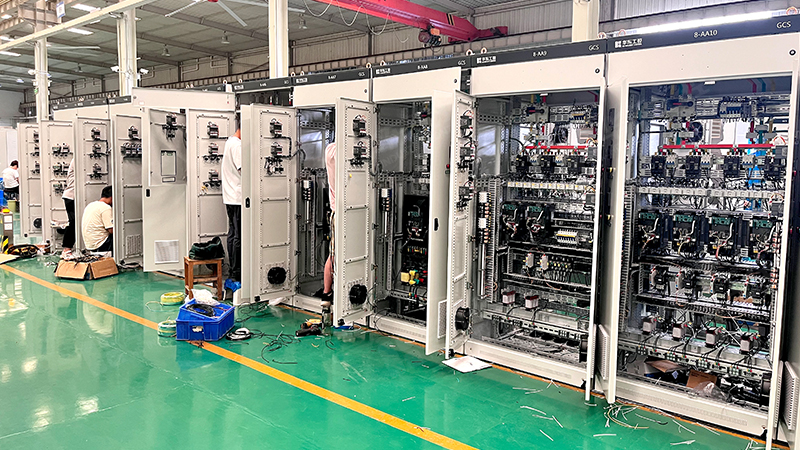
Step 4: Inspect Build Quality & Testing Practices
The lowest price often hides poor workmanship.
Component brands – Are the circuit breaker, contactor, and wiring accessories from reputable manufacturers?
Wiring and labeling – Neat, numbered wires and clear component labels are signs of quality.
Testing – Does the manufacturer perform factory acceptance testing (FAT) including continuity, insulation, and full‑load simulation?
Documentation – You need schematics, BOM, test reports, and user manual.
Common trap – No pre‑delivery test. You receive a cabinet that has never been powered. Faults are discovered during installation, delaying your project. Always ask for a FAT video or witness test.
We follow these four steps for every VFD cabinet we build. Our engineering team helps you define requirements, select the right components, and verify compatibility. We provide full documentation and factory testing – so you avoid the common traps.


